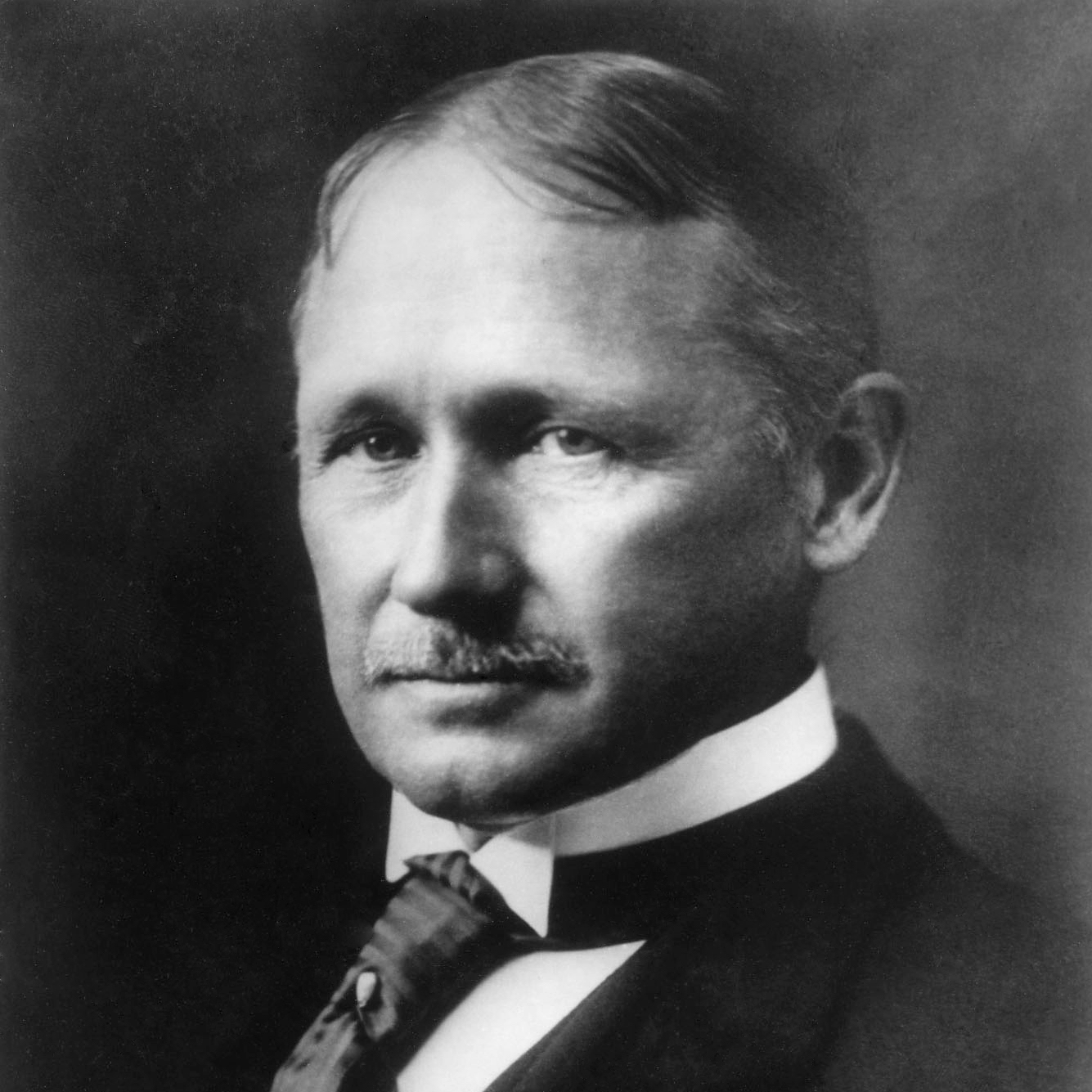
From the late 19th to the early 20th century, Frederick Winslow Taylor developed the first school of industrial-era management thinking. Only about ten percent of workers possessed a high school diploma back then, and there was plenty of manual labor that needed to be systematized. With the increasing complexity of work resulting from technological progress, business owners faced greater risks due to poor quality, inefficient work methods, and excess inventory.
Taylor advocated a strict division of labor between managers and workers. Managers were to design the work, train workers, and supervise them. Workers followed work instructions. Taylor performed time studies to improve work design and argued for replacing time-based compensation with piecework compensation. He believed the latter would reward productivity. While Taylor himself referred to his school as Scientific Management, it has also become known as Taylorism.
Taylorism was often criticized because of the lack of worker empowerment. Education levels improved in the ensuing decades, however, and management thinking evolved to bring workers into the design and management of work. New disciplines such as Lean and Six Sigma helped firms continuously optimize repetitive work. They trained workers to identify problems, determine their root cause, and implement remedies. These methods were also applied beyond manufacturing and used to improve service delivery.
In the 1980s, organizations began using IT to organize and automate business processes and routine management work. In the mid-1990s the commercial Internet emerged, and fifteen years later we got the first smartphones. The stage was now set for linking customers with service providers on a just-in-time basis.
For work that can be defined, but not yet automated, labor marketplace organizations such as Uber and TaskRabbit provide a more capital efficient and flexible alternative to conventional employment. These firms automate most management functions. Participating contractors are not involved in work design. Labor marketplace organizations represent a return to Taylorism, but a better term would be Digital Taylorism. Workers no longer have a human supervisor.
In the last five years, a new class of labor marketplace organizations has emerged, one where human contract workers are engaged to train AIs. The humans perform tasks that typically involve object recognition and classification — in images, video, audio, or text. This is referred to as data labeling, and the data is used to build data sets for training train AIs to perform the same tasks.
Leading ventures in this category include Lionbridge, Hive, Figure Eight, and Mighty AI. The latter focuses on creating datasets for autonomous driving. The company awards completed tasks with experience points and modest amounts of money. Lionbridge claims more than 500,000 contributors and Hive more than 800,000. There are people all over the world, including in refugee camps, doing this work.
Consolidation is inevitable as the “supply chain” for AI begins to emerge. Figure Eight was acquired by Sydney-based Appen for $300M in March, and Mighty AI was acquired by Uber in June for an undisclosed sum.
Because data labeling is in many cases a bottleneck to AI implementation, the demand for data sets is expected to increase. A Financial Times article cites a January 2019 report from Cognilytica projecting the market for data labelling to reach $1bn by 2023. The demand for data labeling labor, however, will eventually diminish. It will be less costly and faster to acquire already-labeled data sets. Data labeling tools are also becoming more sophisticated, which will improve contributor productivity.
Labor marketplaces will continue to exist for both digital and physical commodity work that has not yet been automated, either to perform the work or to gather data to automate it. The tasks that comprise commodity jobs will be automated in the order of economic and technological feasibility, and humans are being tasked en masse to help make this happen. We refer to this phenomenon as Meta-Taylorism. Repetitive work is performed to learn about the work.
When the tension around IT outsourcing was at its peak, we often heard stories about embittered white-collar workers who found themselves training their lower-paid replacements. Meta-Taylorism is the phenomenon of humans (indirectly) training their AI replacements, and AI will increasingly be used to manage this process.