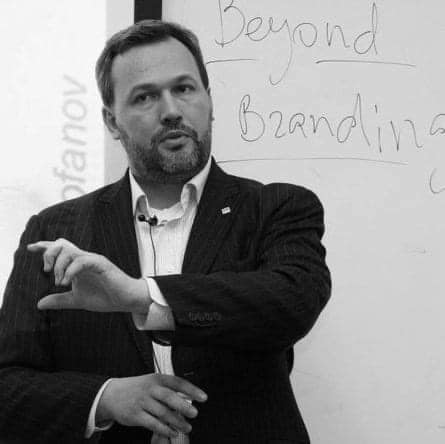
Remembering Sergei Mitrofanov

Aug 15, 2022

Early in the morning on August 4, I learned that our CMO and my dear friend and mentor, Sergei Mitrofanov had passed away suddenly the day before. The news came as a shock to friends, family, and colleagues around the world. Sergei was a vigorous man in his mid-fifties who enjoyed cycling, not someone you would expect to have a heart attack. He had so much to offer, so much undone.

Sergei was a branding genius. He had mentored hundreds of startups and worked with a long long list of international corporate brands during his career. I felt very fortunate to have him working with us, and even more so to count him as one of my close friends.  Sergei is responsible for everything that is good about our branding and positioning, but more fundamentally, he was someone I could talk to about my work and about life in general. The Sergei I knew for many years was a profoundly good man with rational values. Not only was he exceedingly creative and intelligent, he was also benevolent and kind.

Sergei helped add to my knowledge and talents. He saw me at my best, and also at my worst, when I was filled with frustration that we couldn’t get things done faster, sooner, better. He always encouraged me to find something positive, to find a way forward. I always felt better after talking with Sergei.

It has taken me almost two weeks to be able to sit down and write this.  There is still so much I want to speak with Sergei about, but somehow we must continue without him.

Sergei leaves behind a loving family as well as  innumerable friends and admirers all over the world. I feel I belong to all three categories. Now I must build on what Sergei taught me and honor him by implementing what we dreamed about.  

Thank you, Sergei, thank you for everything.

Frode L. Odegard
Founder and CEO, Post-Industrial Institute

You may also like:

Management: From the Stone Age to the 20th Century

Management: From the Stone Age to the 20th Century

As exciting as it is to talk about automating functions within firms, it’s important to understand why these mechanisms exist in the first place. It turns out that they are very, very old.​The oldest evidence of stone tool production goes back 3.3 million years…

Can a firm have a will of its own?

Can a firm have a will of its own?

We all know that organizations consist of people, or at least that has been the case before the emergence of AI agents. While we know that individuals make decisions about what to do, when to do it, how to do it, and why, it sometimes seems like organizations have a…

2025: Opportunity in Turmoil

2025: Opportunity in Turmoil

This year will be characterized by the emergence of AI agents in enterprises. Over the next decade, we believe that firms will be transformed in ways that would have been unthinkable only a few years ago. ince World War II, we have viewed organizations as…

Computing without Boundaries

Computing without Boundaries

From the earliest flight simulators to the computers now embedded in everything from toasters to cars, we have tried to transport ourselves into a digital space or attempted to bring a digital space into our physical environment. Until now, it has been either-or for…

2024 Challenges: AI, Turmoil, Talent

2024 Challenges: AI, Turmoil, Talent

CEOs face significant challenges this year, with a turbulent macro environment and virtually every industry holding rich opportunities for disruptive innovation. Based on our research and interaction with Global 2000 leaders and investors, we believe the following…

Transformation Trade-offs

Transformation Trade-offs

Much has been written about the need for enterprise transformation and the obstacles that leaders invariably face. Many look for the One Best Way (a la Frederick Taylor) to achieve transformations, but the awkward truth is that leaders always have to make trade-offs…

The New World Disorder

The New World Disorder

We should embrace the ideas and values that made the West great and that helped people prosper around the world. Our freedom is our most precious tool for addressing the problems and opportunities that lie before us. Two events took place in 1989 that signaled two…

Leading the Unwilling

Leading the Unwilling

In the emerging post-industrial work landscape, how can leaders persuade people to stay and pursue the organization’s goals?  Before the pandemic arrived, the relationship between firms and people had become much more loosely coupled. Half of millennials in the…