We are less than a full month into 2026, and anyone brave enough to check the news headlines will immediately experience an increased blood pressure. The pace, complexity, scale, and uncertainty of the events we see unfolding pose tremendous challenges to organizations. How can they keep up and avoid potentially devastating blind spots?
The changes we are seeing are taking place across a range of domains:
(1) Domestic politics in the United States is becoming increasingly polarized, with greater tension between States and the Federal Government. As the country approaches its 250th anniversary, large segments of the population have fundamental differences in what they believe is true and what should be done about it.
(2) U.S. industrial policy continues to be interventionist. We see the Federal Government picking winners, through subsidies, tariff relief, revenue sharing, and equity stakes. With a return to protectionism, some industries face significant cost increases for products they must import from abroad. This has already resulted in a higher cost of living for U.S. consumers.
(3) Geopolitics is in rapid transformation. The post-war rules-based international order is fading and looks to be replaced by a multipolar world with protectionist trading blocs. Russia continues its assault on Ukraine. China is becoming more assertive abroad, and continues its oppression domestically. The U.S. has deeply undermined the trust of its NATO allies, with threats to annex Greenland and aggressive moves toward Canada. The result will be a more distant relationship with Europe and Canada. The EU is inking trade agreements with India and Latin America, but has suspended ratification of its agreement with the U.S. We also see European countries talking about reducing technology dependency on the US. Supply chain management must adapt to frequent changes in tariff rules, as market access is increasingly used for political leverage.
(4) Rapid advances in AI and robotics are reshaping the job landscape and transforming how firms operate, upending entire industries in the process. AI is also accelerating progress in science and technology more broadly. We can expect increasing competition even in mature industries, where startups now have unprecedented opportunities to mount serious challenges to incumbents.
Tracking the multiple layers of these technologies—their interactions, their rates of improvement, and their future capabilities—is difficult even for technologists. In Silicon Valley alone, there are several AI-related events every day, easily more than a hundred each month.
Thomas Friedman’s 2005 book, “The World Is Flat”, argued that globalization had resulted in an “even playing field” where individuals and firms from anywhere in the world could compete [1]. The Internet, outsourcing, and supply-chain management made it possible to rapidly develop new products and services, and offer them in faraway markets. Is clear that this thesis must be revisited; markets are fracturing, not unifying.
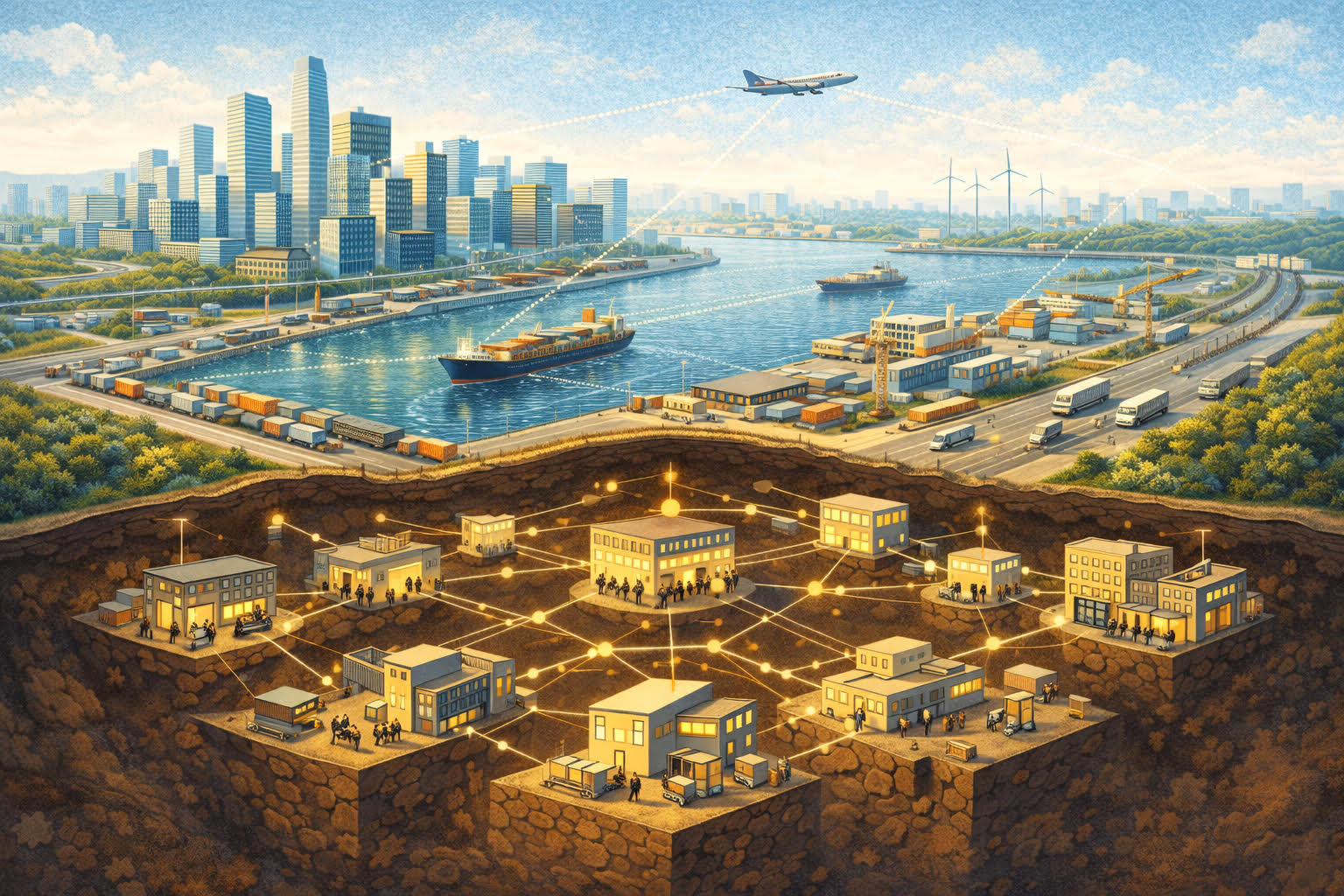
At the same time, there are new industry standards for AI agents under development that will have a similarly dramatic effect on commerce as the shipping container had on global trade of physical goods [2]. For digital products and services, these will likely have a unifying effect, but for the trade of physical goods the main impact will be to make supply chain adaptation much more efficient.
For organizations to successfully navigate our increasingly fast-paced and complex world, it is critical that they improve their organizational intelligence. We define organizational intelligence as the ability for organizations to detect, understand, and address problems and opportunities. In their landmark 2000 book “The Knowing-Doing Gap”, Stanford University professors Jeffrey Pfeffer and Robert Sutton explored how organizations could better share knowledge internally and convert knowledge into action [3]. What happens, though, when in spite of such practices, the volume, uncertainty, and complexity of external changes continue to increase relentlessly?
Conventional knowledge management practices and tools are no longer sufficient . The cognitive burden will be such that the speed of adaptation will not keep up with the pace of change in the external environment. We use the term “adaptation” here purposefully — it is not enough for an organization to merely “respond” to new knowledge. The organization must be able to change its structure as well — it must become rapidly reconfigurable.
We believe AI agents will be indispensable for firms seeking to increase their organizational intelligence and maximize their adaptive ability. AI agents can provide shared access to a unified knowledge layer. They can absorb new facts and effect instant organization-wide knowledge of them. AI agents can collaborate to solve problems and take rapid action in pursuit of agreed-upon goals. They can also dynamically change the structure of the organization much faster than what is possible for human managers.
Join us at the Post-Industrial Summit on February 4-5, 2026 to explore organizational intelligence and other advanced topics as we advance toward Autonomous Organizations.
References
- T. L. Friedman, The World Is Flat: A Brief History of the Twenty-First Century, New York, NY, USA: Farrar, Straus and Giroux, 2005.
- M. Levinson, The Box: How the Shipping Container Made the World Smaller and the World Economy Bigger. Princeton, NJ, USA: Princeton University Press, 2006.
- J. Pfeffer and R. I. Sutton, The Knowing-Doing Gap: How Smart Companies Turn Knowledge into Action. Boston, MA, USA: Harvard Business School Press, 2000.