As exciting as it is to talk about automating functions within firms, it’s important to understand why these mechanisms exist in the first place. It turns out that they are very, very old.
The oldest evidence of stone tool production goes back 3.3 million years to a site in Kenya, long before the first species of Homo [1]. To do this work, the makers must have been able to develop and pass on a method with well-defined steps performed in a predictable sequence.
When the Oldowan industry emerged around 2.6 million years ago with the rise of early Homo (likely Homo habilis), tool production became more systematic [2]. Flake tools show evidence of standardized sequences: preparation of a core, controlled removal of flakes, and reworking edges for specific tasks. This reflects a cognitive scaffold: decomposition of tasks, repeatable procedures, and transmission of skill. These are the earliest archaeological traces of workflow as an inherited cultural pattern — before the emergence of Homo sapiens.
As Homo sapiens emerged around 300,000 years ago, toolmaking became more sophisticated and specialized. Humans were expanding earlier workflows into structured production systems. By the time of the Upper Paleolithic (after ~50,000 years ago), toolkits had diversified into blade industries, composite tools, bone, and other implements. Many of these tools could only be produced through extended apprenticeship, role differentiation, and collective knowledge transmission.
Toolmaking is our earliest example of structured, shared, and scalable work. It has been with us from the birth of our species.
Management of work requires goal-setting and supervision of resources and people across time and distance. This was greatly helped by another innovation — writing. Writing began with arithmetic. We can all do simple arithmetic in our heads. Research shows that our brains (and brains of lesser species) have the built-in capability of handling a handful of objects, but counting beyond that is a skill [3].
Arithmetic began with counting. Early methods of counting used bodily reference points, e.g. fingers and toes. Human memory capacity is limited, and being able to externalize information means we can share with others. By at least 20,000 years ago, humans were leaving tally marks on cave walls and bones, likely counting days and lunar cycles. They also kept track of animals and everyday objects.
Starting about 10,000 BCE in the Fertile Crescent, the first humans had transitioned from hunting and gathering to full-time agriculture, The Neolithic Revolution had arrived. Agriculture led to rapid innovation in toolmaking, and there was an increasing variety of goods that were produced and consumed. With a far greater number of objects to keep track of, tally marks were not enough. The solution was to use clay tokens, which emerged around 8,000 BCE.
Each token had a shape signifying the type of goods counted. For example, an ovoid stood for a jar of honey or olive oil. They facilitated resource management as well as trade. A cone stood for a small amount of grain.
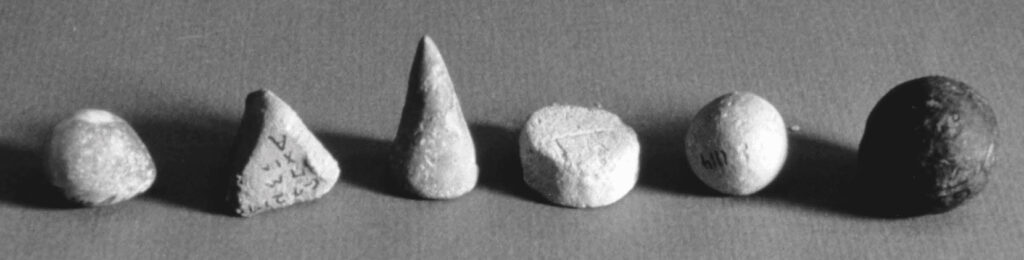 Clay tokens. Photo by Prof. Denise Schmandt-Besserat.
Starting in the early 1970s, Prof. Denise Schmandt-Besserat at UT Austin spent twenty years discovering and cataloging the clay tokens, determining what they represented, and worked out how they had evolved into the world’s first writing system [4].
As the number of types of tokens grew from about sixteen basic shapes to nearly 300, it became necessary to better organize and secure them. By 3500 BCE, agriculturalists would seal the tokens into hollow clay envelopes (bullae). The next step was to press the tokens into the surface of the bulla so its content could be verified without breaking it open. This led to pressing tokens into a flat clay tablet. By 3300 BCE the tokens themselves were deemed unnecessary, as symbols could simply be incised into the tablets. This was the beginning of cuneiform writing, the first writing system.
In a pattern we will see again and again, organizational “mechanisms” (technologies, tools, and practices) are developed to solve a practical problem.
Another key technology that reshaped how we lived was metallurgy. Starting in 9000 BCE in the Levant and Anatolia, we have the earliest evidence of metal use [5]. Humans were hammering pieces of copper found in nature and used them to make tools. By 7000 BCE they were heating copper in the fire to make it easier to shape, and by 5000 BCE smelting had been developed.
Around 4500 BCE there was a shift from hammering to shape the objects to using stone and clay molds. This was a tremendous breakthrough because it allowed mass-production of standardized shapes (e.g. axes and chisels). By the end of that millennium we see mixing of metals to achieve better properties.
By 3300 BCE humans had learned to produce bronze by mixing copper and tin. Bronze was widely used for tools, weapons, armor, and ornaments. There were specialized metallurgical workshops and specialized craftsmen.
The cumulative effect of these innovations (agriculture, counting systems, writing, and metallurgy) was the Bronze Age (3300 BCE – 1200 BCE). The Bronze Age gave us the first civilizations, starting with Sumer, Elam, and Egypt. A civilization is a culture with state formation, urban centers, a standard writing system, calendars and astronomy, mathematics for accounting and land management, written laws, administration, record-keeping, and social stratification.
By the end of the Late Bronze Age, the eastern Mediterranean and Near East formed an interconnected world of powerful and highly organized civilizations. These included Egypt, the Hittites, Mycenaean Greece, Babylonia, the Assyrians, Ugarit, the Phoenicians, and Cyprus. They all operated sophisticated administrative systems, managed long-distance trade, deployed professional bureaucracies, and coordinated armies, agriculture, and taxation with remarkable precision.
The Bronze Age introduced a large number of management mechanisms, almost all of which are still in use:
Information Architecture
- Standardized records and accounting tables
- Standardized weights and measures
- Audit practices
- Archival storage with cataloging systems
- Quality control inscriptions
- Finance and Commerce
Banking and credit
- Loans, interest, collateral, and enforcement
- Commodity money (barley, silver, copper)
- Standardized metal ingots
- Marketplaces
Organizational Structure
- Hierarchical management (overseers, foremen, scribes)
- Workforce scheduling and ration-based payroll
- Specialized roles and early “departments”
- Apprenticeship and skill-transmission systems
Production, Supply Chains, and Infrastructure
- Inventory management (granaries and warehouses)
- Standardized production using molds
- Project management for large works (canals, temples, walls)
- Long-distance supply-chain coordination
- Roads, ports, and transport networks
Governance and Law
- Written law codes (property, contracts, family, debt, crime)
- Formal written contracts and sealed agreements
- Taxation and tribute systems
- Temple–palace redistribution mechanisms
- Laws governing rights and responsibilities of commercial agents
Strategy
- Written military strategy (earliest tactical plans, order-of-battle lists, campaign logistics)
- Diplomatic correspondence (e.g., Amarna Letters, interstate negotiation, alliance-building)
- Long-range planning (tin routes, copper networks, agricultural surplus, irrigation)
- Risk management (omen texts, predictive models, intelligence gathering)
- Crisis coordination mechanisms (famine relief, mobilization of labor and armies)
- Royal strategic administration (king as chief planner; role separation between political, military, and economic leadership)
Subsequent eras saw many important improvements and refinements, and we will attempt to summarize them below.
In the recovery from the Bronze Age Collapse, there was a significant Greek migration to the West Coast of Anatolia. There, Greek towns became independent Republics with access to the rest of the Mediterranean via their own ships as well as those of the Phoenicians. They also had inland access to Babylon, which still retained knowledge from the Bronze Age.
Around 800 BCE, the Greeks had adapted the Phoenician writing system to write Greek, and in the process created the world’s first proper alphabet. This was a tremendous advancement for three reasons: (1) The Greeks had forgotten to write for four hundred years after the Collapse; (2) with the new writing system literacy spread rapidly; (3) having an easy-to-use alphabetic writing system also made knowledge sharing much easier.
With peace, prosperity from trade, and a cosmopolitan population, the Anatolian Greeks were in a perfect position to begin a period of intellectual flourishing. This is known as the Ionian Enlightenment, and it sparked the beginning of Greek philosophy, mathematics, and science in the 600s BCE.
To their East, the Carians standardized metal ingots, and the Lydians minted the first proper coins. This innovation spread rapidly to the Greeks as well as other countries in the region. With coinage came more sophisticated banking with access to credit, which again stimulated trade.
The Greeks did not just give us philosophy, they also taught us how to think about governance. After the collapse, their republics had been ruled either by tyrants, oligarchs, or aristocrats. In 508 BCE Cleisthenes introduced reforms in Athens that gave every citizen the right to vote on legislation [6]. He called it Isonomia, meaning equality before the law. Cleisthenes also implemented random selection for government positions as a countermeasure against corruption. Around 350 BCE, Aristotle authored a comparative work, The Politics, based on a comparison of 158 constitutions that his students had researched [7].
The Romans also made important contributions to management [8]. They were the first to pass laws that recognized a firm as a legal person (a collegium). Collegia had officers, could own property and conduct business, could sue, and be sued. The Romans had a sophisticated banking system that would not be equaled until modern times. They also developed road and aqueduct infrastructure for fast, reliable communication and transportation.
The Islamic Golden Age introduced paper for inexpensive record-keeping, which led to a massive expansion of written administration [9]. They also introduced checks, bills of exchange, and charitable endowments.
In the High Middle Ages and Renaissance, Italian city-states developed insurance businesses, and joint ventures, though these had all first been invented in the Bronze Age. In 1494, Luca Pacioli published his text Summa de Arithmetica. Here he described double-entry bookkeeping, the first real advance in accounting since the Bronze Age [10].
The Enlightenment and Scientific Revolution transformed how societies understood knowledge, authority, and governance. The idea of governments as a protector of Natural Rights led to the founding of the United States. Its constitution leveraged past insights about scalability, agility, and resilience. Governmental authority was seen as stemming from Rights and Reason, as opposed to hereditary privilege. Firms founded in the United States have an approach to governance that mirrors the U.S. constitution.
The Scientific Method provided a path to objective knowledge and organized learning. Scientific societies, journals, and academies formed early systems of knowledge exchange. Taken together, the Enlightenment and the Scientific Revolution provided sufficient political and economic freedom, a thirst for new knowledge, and a method for acquiring it. The stage was set for the Industrial Revolution [11].
Beginning in 1760, the First Industrial Revolution transformed production from artisanal workshops into factory-based systems. Manufacturing was increasingly mechanized. Innovations such as the spinning jenny and steam engine dramatically increased output while lowering costs. The deeper change was organizational: factories needed new forms of coordination, time discipline, division of labor, and supervisory structures. Production now required skilled workers operating under standardized procedures.
Railroads and canals created national markets, enabling firms to scale far beyond their local geographies at a much lower cost. The First Industrial Revolution also gave birth to the professional manager, cost accounting, and increasingly complex, multi-departmental organizations.
Railway companies and manufacturers had to manage scheduling, inventory control, procurement systems, and safety. The telegraph enabled near real-time communication across regions, supporting centralized control over distributed operations.
The Second Industrial Revolution brought electrification, mass production, chemical engineering, and the internal combustion engine. These technologies profoundly changed the structure and speed of work. Factories moved from steam-powered batch processes to continuous-flow production systems. Standardization, interchangeable parts, and assembly lines demanded new management techniques and formalized planning.
Frederick Taylor (Scientific Management), Frank and Lillian Gilbreth (motion studies), and Henry Fayol (administrative theory) provided ideas and practices to optimize labor, workflows, and organizational structure. Corporations expanded into multi-unit enterprises with hierarchical layers, functional departments, and formal reporting lines.
The 20th Century Enterprise was beginning to take shape — large-scale, data-driven, hierarchical, and rule-governed. What people could not have imagined was how much technology would reshape the enterprise and reverse the trend toward centralization.
References
1. S. Harmand et al., “3.3-million-year-old stone tools from Lomekwi 3, West Turkana, Kenya,” Nature, vol. 521, pp. 310–315, 2015.
2. D. J. Clark, The Prehistory of Africa, 2nd ed., New York, NY: Praeger, 1970 — includes discussion of Oldowan and early hominin tool use.
3. S. Dehaene, The Number Sense: How the Mind Creates Mathematics. New York, NY: Oxford Univ. Press, 1997.
4. D. Schmandt-Besserat, How Writing Came About. Austin, TX: Univ. of Texas Press, 1996.
5. R. F. Tylecote, A History of Metallurgy, 2nd ed. London, U.K.: Institute of Materials, 1992.
6. P. J. Rhodes, A History of the Athenian Constitution. Oxford, U.K.: Blackwell, 1981.
7. Aristotle, Politics, E. Barker, Trans., R. F. Stalley, Rev. Oxford, U.K.: Oxford Univ. Press, 1995.
8. C. G. Herbermann, Business Life in Ancient Rome. New York, NY: Macmillan, 1904.
9. D. Gutas, Greek Thought, Arabic Culture: The Graeco-Arabic Translation Movement in Baghdad and Early ʿAbbāsid Society (2nd–4th/8th–10th Centuries). London, U.K.: Routledge, 1998.
10. J. Gleeson-White, Double Entry: How the Merchants of Venice Created Modern Finance. New York, NY: W. W. Norton & Company, 2012.
11. J. Mokyr, A Culture of Growth: The Origins of the Modern Economy. Princeton, NJ: Princeton Univ. Press, 2016.